Momenta Art Benefit – Wednesday May 21st
Get great art at a low price and help fund the long-time running not for profit gallery Momenta Art in Brooklyn. ” momenta art presents its thirteenth annual benefit to support its ongoing mission to support the work of emerging and underrepresented artists.” The raffle tickets are $225 and there will also be work for auction. The benefit is at White Columns, Wednesday, May 21, 5-10PM, Auction: 5-6PM, Raffle: 7-9PM. Get details on the art work available.
Neo Rauch at David Zwirner
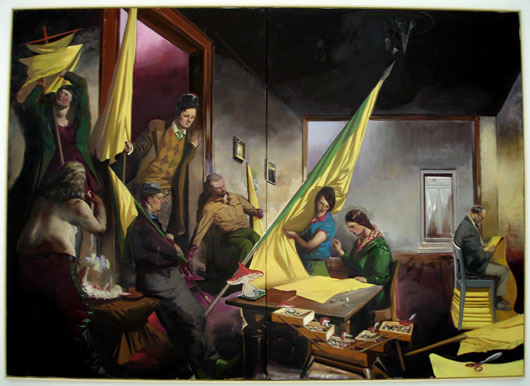
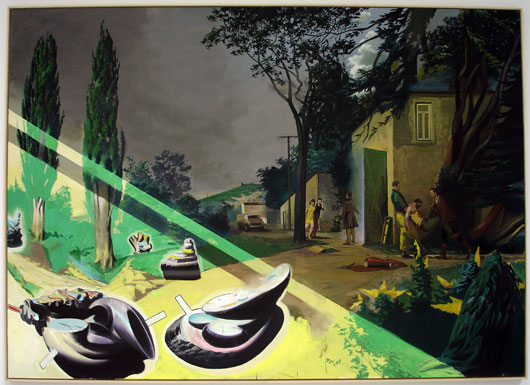
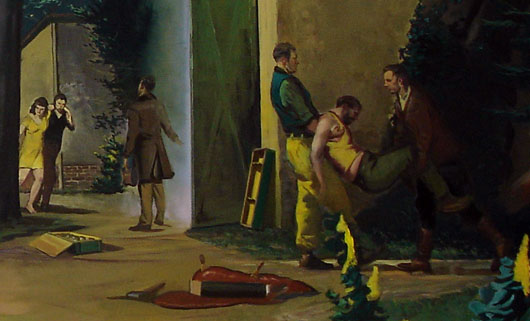
This past week, I made my regular stop through Zwirner and was happy to encounter new work by Neo Rauch, one of my favorite contemporary painters. Rather than trying to describe the individual paintings documented here, I’ll list the general reasons that I’m drawing to Rauch’s work:
1. The heroic scale places the viewer into the painted environment, allowing one to enjoy the rich mixture of painting styles – moments of abastracion embedded within the general social realist setting.
2. The striking power of social realism interwoven with neoclassical depiction to create a displaced narrative. Displaced because various historical elements of varying Western periods are juxtopsed to allude to bourgeois revolutions, industrialization, socialism, the ideals of free time and creative engagement, fascism…
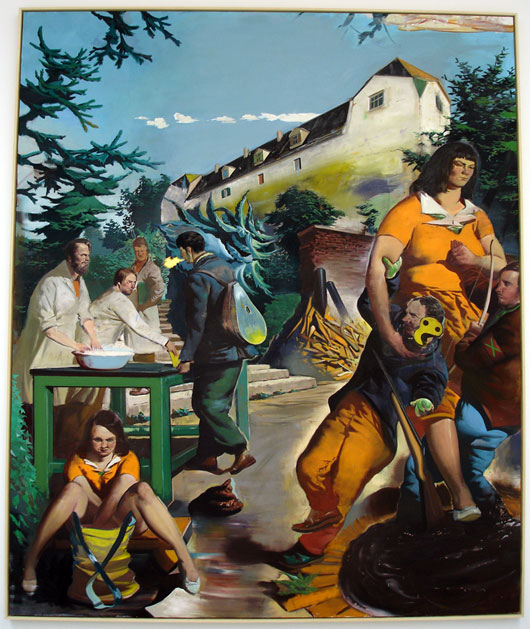
the rise of science, a depiction of German culture and human nature in general… The narratives are rich not only for their masterful use of paint, but because they trigger various learned histories with irrational creative nuances that bring to mind fatastic fables.
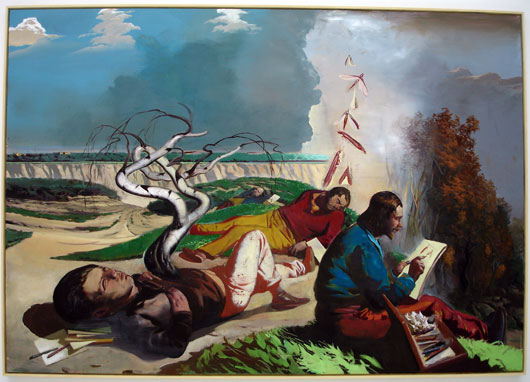
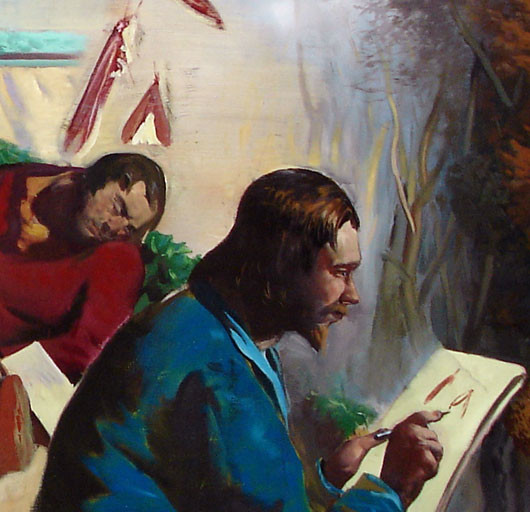
3. Technically – masterful use of paint and color, rich mixture of technical styles.
4. Lastly, I’ll repeat this point, employment of the fantastic that brings to mind old fables.
MUTO by BLU – AMAZING
Robert King Wilkerson and Rigo 23 at the New Museum
A Portuguese voice, a Louisianan voice and a Brit voice
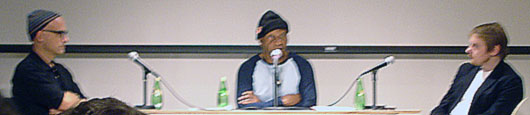
This afternoon I attended a free discussion at the New Museum that was part of Creative Time’s “Hey Hey Glossolalia: Exhibiting the Voice,” a series of free events throughout the month of May. The discussion was between Robert King Wilkerson, former Black Panther who spent 29 years in solitary confinement in the Louisiana State Prison aka Angola Prison, artist and activist Rigo 23 and Creative Time curator Mark Beasley. (Rigo 23 and Wilkerson have been working together for the past 7 years, apparently Rigo 23 is working on a documentary about Wilkerson.)
Robert King Wilkerson is the only member of the Angola 3 that has been liberated from prison. The other two Panther inmates, Albert Woodfox and Herman Wallace remain in solitary confinement, now 34 years, the longest that any human being has spent in closed-cell restriction that is 23 hours alone in a 6-foot-by-9-foot concrete box year after year after year.
The witness of a prison slaying that sent Wilkerson to a life-time jail sentence recanted his story which eventually lead to Wilkerson’s freedom as long as he wouldn’t sue for wrongful conviction. Now Wilkerson travels and speaks and people listen in amazement to a victim of a system that kept him in solitary confinement for 29 years and a total of 31 years in jail. If one stops to consider the psychological implications of spending half a lifetime alone in a small cell 23 hours of each day, it’s difficult to imagine how sanity may be retained.
Robert King Wilkerson is not only lucid, he’s a powerful speaker who triggers the imagination and hope. When asked how he kept his sanity, Wilkerson states that it was his innocence, that although he was in prison, he wasn’t going to allow prison get in him, his love to think, to dream, dream as a form of talking to himself. He also had lots of nightmares, but the dreams out-shined the nightmares.
In closed-cell restriction (ccr), prisoners are not allowed to speak, so talking to oneself in the cell and out loud to other prisoners during the one hour time out of the cell became a method of contestation and protest. “We weren’t going to let anyone from keep us from talking, no matter how many times they’d write us up. We’d tell them to write us up…” In talking about the power of voice, Wilkerson quotes his fellow Panther inmate Herman Wallace – “The deeper they bury me, the louder my voice becomes.”
When asked about the purpose of art and activism, Wilkerson states “thay you can use your hand, you can use your talent… to tell a story, a work of art can encompass a great deal.” His point being that art may be a very powerful means for change in our society. However when Rigo 23 was asked about his practice as an artist and activist, he stated that it’s “hard to not be overcome with a sense of futility, get overwhelmed with distractions and that he has left art to try to get something undone and from Robert to learn how to deal.” Rigo 23’s “One Tree” mural in San Francisco that points to a single tree next to the highway South of Market is amongst one of my favorite public works, so hopefully he’ll return to art in some way. Although when the curator who moderated the panel isn’t familiar with Act Up’s long time, powerful logo – the pink triangle over the phrase “Silence = Death”, one can’t help but question the point of activism in today’s Art World.
Documentary filmmaker, Jimmy O’Halligan is working on a film about the Angola 3; preview is available on youtube.
Stop the Raids and Deportations, May 1st Rally, NYC
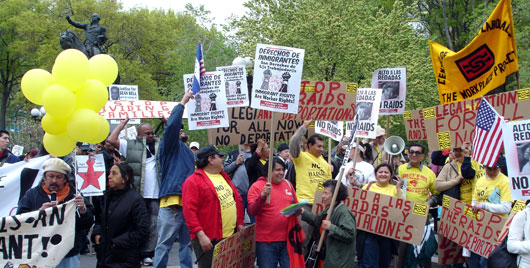
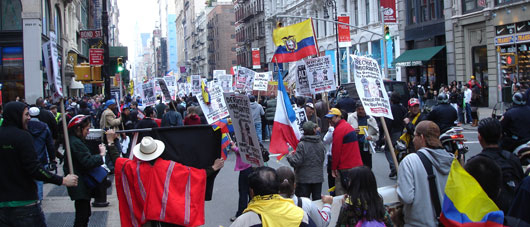
May Day was celebrated in strength yesterday at Union Square where several hundred people gathered to listen to speakers and music that questioned the deportations of laborers, demanded immigrant rights and celebrated multiculturalism. The gathering of several hundred grew to several thousand as the May Day activists marched from Union Square to City Hall.
At a time when all the news seems bleak – continued death of innocent people and soldiers in Iraq and Afghanistan, the increasing cost of groceries and gasoline, a growing popularity of McCain – the candidate who hopes to continue the Bush Administration’s failed agenda… it was reinvigorating to have a joyful gathering demanding citizen rights for those immigrants who help keep the city running.
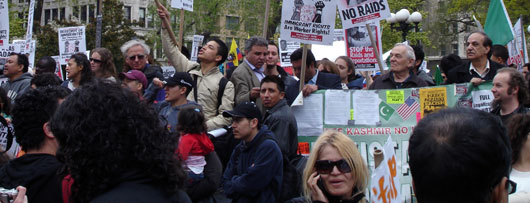
Every human color and age was present at the rally. It was an exciting mix of generations, languages and cultures enjoying the right to demonstrate in one of the greatest cities of the world. Amongst the points of protest were the raids of work places to deport laborers and markedly a protest against last week’s verdict regarding the killing of Sean Bell by 50 police bullets.
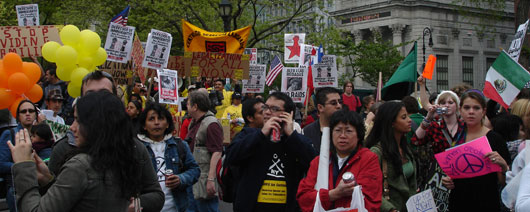
As the rally spilled from an enclosed area in Union Square onto Broadway, the number grew to the thousands, where tourists were taken by surprise.
VOTEMOS.US Weekly Video Podcast Now Available
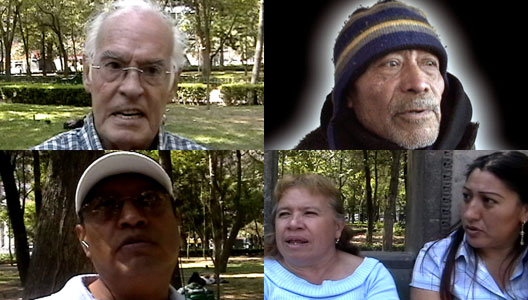
VOTEMOS.US the site that questions what the 2008 U.S. presidential elections would look like if all residents in the U.S. could vote will now feature weekly video interviews with U.S. immigrants and Mexico City residents concerning the presidential elections and general relations between the United States and Latin America.
Although VOTEMOS.US is a Spanish-language site, the videos have English language subtitles so that U.S. citizens may have an insight into the views of their Spanish speaking neighbors within the country as well as those south of the border. The weekly video interviews are available on the site, as a podcast or rss feed:

This week Argentine Jose Antonio Lazzari relaxing in the park Alameda Central located in the historical center of Mexico City states that he would not vote for Obama, Hillary or McCain and he questions who the leftist candidates are in the U.S… Jose Antonio goes on to point out that the United States is controlled by the transnational companies that are making a fortune in Iraq.
We had a lengthy conversation with Jose Antonio Lazzari, a theater actor and educator who runs a free school in Argentina. Sections of this conversation will be published over the next few weeks. Past interviews with NYC undocumented resident Raymundo are also available and all videos will be archived on the site.
New Media Artists from Mexico City
On Wednesday April 9th, I was fortunate to be invited by curator Karla Jasso to a small presentation by a group of Mexican artists at el Laboratrio Arte Alameda, the beautiful colonial church converted into a new media center in the Historic Center of Mexico City.
I had met a few of the people present at the meeting during my stay in Mexico City for Transitio_MX02 last fall, but I had only seen one or two works by the artist presenting that afternoon. I came away from the meeting impressed and excited by the work that I had seen. Some of the work reminded me of projects I saw coming out of Carnegie Mellon University in the 90s, but entirely re-contextualized by the environment and culture of Mexico.
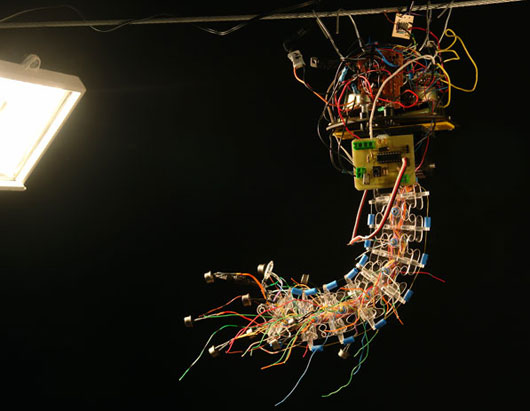
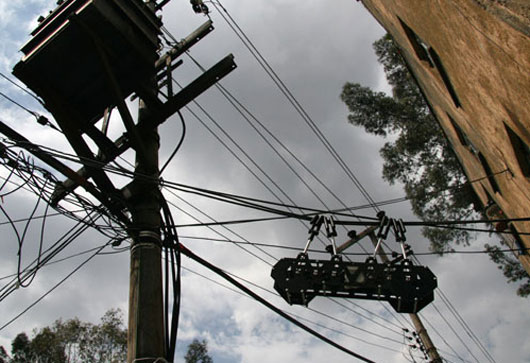
For example Gilberto Esparza’s robotic urban parasite series recalled the work of Simon Penny, particularly projects such as Petit Mal or Sympathetic Sentience. As Simon puts it: “robotic artwork which is truly autonomous; which is nimble and has ‘charm’; that senses and explores architectural space and that pursues and reacts to people…” However Gilberto Esparza’s creations are the rougher, tougher, streetwise cousins of Penny’s works.
Inspired by the street vendors (ambulantes) of Mexico City, who set up a sidewalk shop and will take electricity from a near by electrical post to establish a cozy store with light, television and radio, Esparaza’s “Parasitos Urbanos” (Urban Parasites) use the electric cables for power and as a means of movement. Pictured below are mrñ (maraña), dblt (diablito – little devil), “clgd” (colgado – hanging). Each of these creatures feeds from the electric cables that they use as a mode of transportation, they emit sound and through a series of sensors react to their surroundings. Watch the linked videos to see them in action. As much as I like the hanging species, I think that my creatures exist with the trash – ppndr-s (pepenadores) live near the gutters amongst the trash, playing, moving objects about.

Ivan Puig also presented his work. I was most intrigued by a current collaborative project in which he is creating a vehicle that will drive along abandoned railroads throughout Mexico. The vehicle will document these regions that were once vital economic hubs, but have been left abandoned as the railroads are no longer in use. People will be able to virtually ride along these abandoned tracks in real time by login to the site that will present live streams from the vehicle. Ivan also presented a large scale sound installation that recycles old technology to create a series of instruments that people may interact with.
Also amongst the presenters was Laboratorio Curatorial 060, a curatorial collaborative group that addresses various social issues by programming thematic exhibitions that commission new works from artists.
Artist Ivan Abreu presented his poetic combination of conceptual and new media art. Amongst my favorite of Ivan’s recent works is a sound performance using a record made from ice with Mexico’s National Anthem pressed onto it. He plays the anthem on a record player, but as it plays the ice begins to crack and melt, the record breaks and the artist struggles to keep it together so that it will continue to play.
In the midst of globalization, real-time communication networks, and the structuring of artistic production into a market-based system from education to the museums and galleries, it’s difficult to find artistic production that isn’t influenced by 20th century Western avant garde movements. What I find striking and exciting are the regional nuances that contemporary art production incorporates or that the most creative element by the artist is the manner that ideas and production are transformed according to the reality at hand.
We live in a cultural collage, that is to say, that the world is an assemblage of histories, people, products that traverse the globe. Through the sharing of information and knowledge, once distinct lineages of production are no longer distinct to a particular time or place, so it’s interesting to see how this information is hybridized in different locales. I’m not saying that this is anything new, it’s just fun to see it in the new media landscape and to pay witness to it (perhaps it just means that I’m getting old).
Ale de la Puente, Mining her Subconscious
Imagine being highly susceptible to hypnotism and electing to give yourself over to a series of trances investigating your subconscious. When in your normal state you do not recall what you said or how you behaved during the hypnotic state, however emotionally you have undergone a transformation. You now feel a sadness and may cry for no apparent reason. These are a few of the sensations that Mexican artist Ale de la Puente experienced during a period of personal investigation with a Canadian hypnotist.
Ale traversed her past and her subconscious projection into her future. She put herself in the trust of a hypnotist to experience and pay audience to the power of her subconscious (pay audience by watching the video documentation of her trance states). Following this intense periods of hypnosis, Ale’s hypnotist proposed one more trance to offer her a gift. Following the final trance, Ale experienced a week of incredible happiness.
This is the personal territory that has informed Ale de la Puente’s current installation at kbk arte contemporaneo, a gallery in Mexico City directed by Ubaldo Kramer. Ale has created a visually rich landscape entirely made of confetti; more precisely a mountain scape of confetti formed through celebration. By throwing a large amount of confetti about the room, eventually a series of mountains appeared. She finalized the confetti-scape by placing specific colored confetti onto the shapes, creating a series of color plateaus. The confetti composition is accompanied by a series of beautiful photos documenting the process.
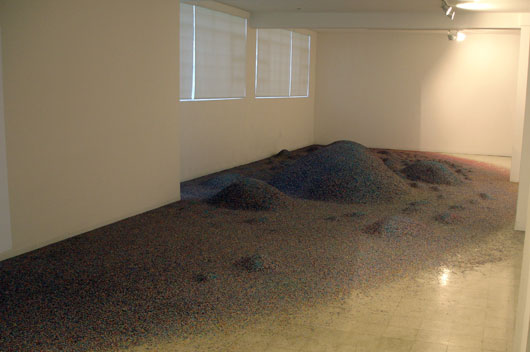
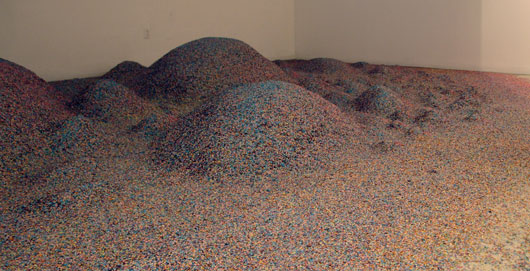
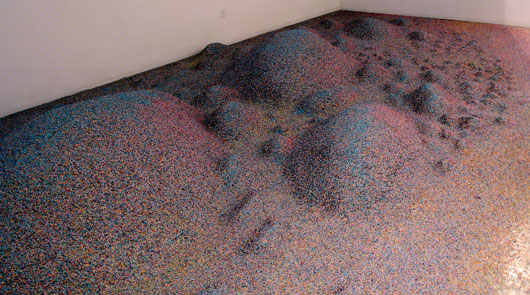
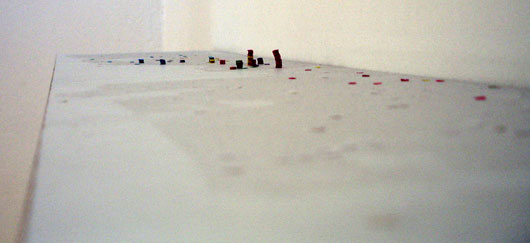
Ale de la Puente at kbk arte contemporaneo, Mexico, D.F.
Murakami, Soap Box Event… Art in NYC
I’m too tired to comment much, but I’ve got lots of images accumulating without sharing. There’s been so much art in NYC lately that the work I shoot just ends up on my desktop. Here are a few from today:
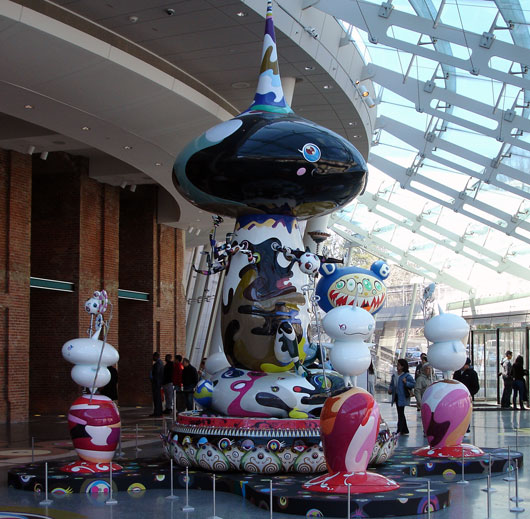
I’ll never understand Murakami’s stuff – as long as people can’t ride it, what’s the point… well, other than making lots and lots of money. Takashi Murakami has a show at the Brooklyn Museum, I haven’t checked it out, but was briefly visually entertained by what’s in the lobby. Even the kids stare in awe, but it fades fast once they realized they can’t touch or ride the stuff… crazy eye candy.
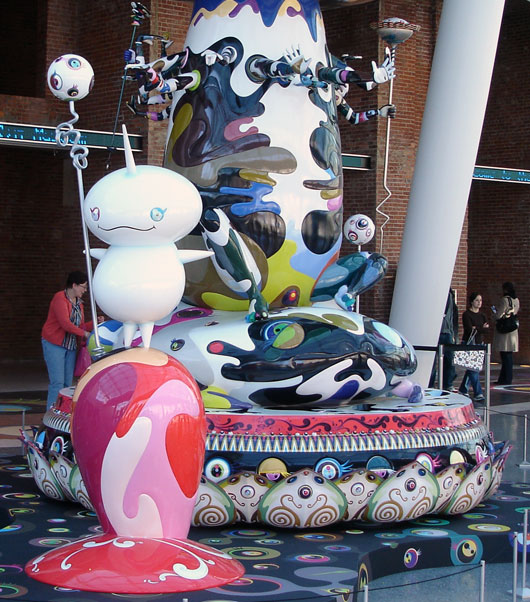
Hopefully he’ll open an amusement park that hands out free acid upon entry.
Afterwards, I hiked it over to Wall Street to catch the tale end of Pia Lindeman’s Soapbox Event, where kids took turns outside of Federal Hall to get people’s attention and inspire participation.
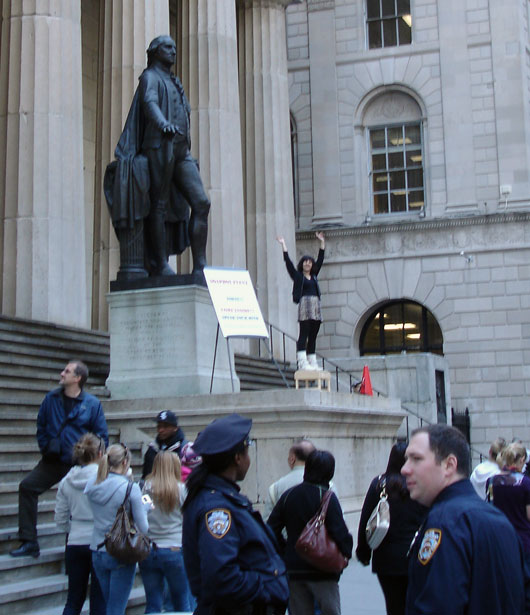
And inside participants were given a nice new soapbox to stand on and exercise their freedom of speech. Assuming that there really wasn’t much of a point in addressing the ongoing wars that US citizens contribute to and allow to continue while hundreds of thousands of innocent people die along with several thousand US military… I complained about the dog shit and piss that litters the streets of NYC.
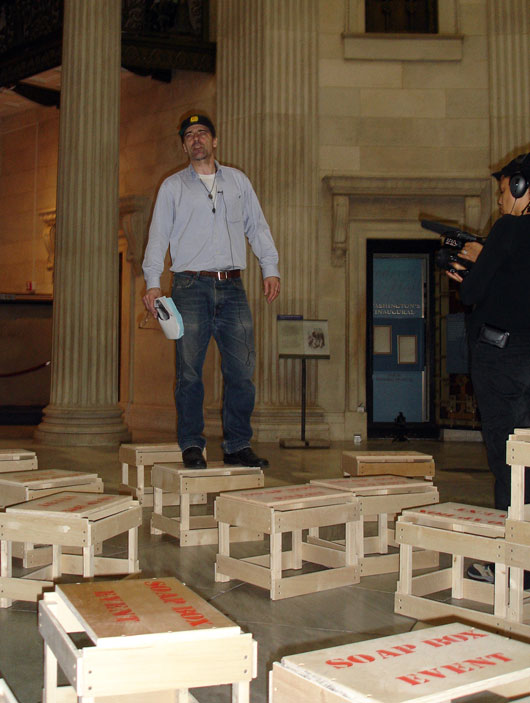
By the time I got there, most of the audience were the assistants, but given all the boxes on the floor, it was clear that there was lots of participation. It seems as if the street would present a stronger venue.
And at the end of the afternoon, I made it to Martha Wilson’s exhibition at Mitchell Algus Gallery. On exhibit are a few of Martha’s early works, executed between 1971-74. It’s the work of a young woman, a feminist, a critical thinker that remains powerful today. The NY Times has an excellent review of the show.
Naomi Klein – short sighted and mistaken
After watching the video by Alfonso Curan inspired by Naomi Klein’s The Shock Doctrine: the Rise of Disaster Capitalism, I read “Latin America’s Shock Resistance” an article by Klein that briefly articulates some of the primary ideas behind the book. I have yet to get my hands on the book, but the article really angered me, so I had to write something in response, even if just a note to myself.
The article is a good read, but way too optimistic for me. For every positive change toward democratic socialism that the article sites, there are any number of privatizing and culturally negligent changes that are not mentioned, and are all too real to ignore. This for me takes a great deal out of Klein’s perspective. She’s right, Latin America has grown tired of the United States’ influence and power, changes are being made that counter 100+ year traditions such as School of the Americas and the banana republic diplomacy; these are changes that have been fermenting popularly since the 80s and for some groups much longer. But there are new transformations occurring based on transcapitalist models that are not being countered and not being fully understood, yet.
I know what is happening in Nicaragua first hand, so it’s the only place that she mentions that I can write about and she is entirely mistaken. Much of the beautiful, untouched beach front property on the Pacific has been purchased by foreign wealth, primarily US development contractors and small pieces by retirees. The once untouched rain forests of the country have been deforested. At the current rate of deforestation the majority of Nicaragua will be a desert in the very near future. On paper the rate of deforestation has lowered, but in reality a great deal of illegal deforestation continues, even under Sandinista watch – the money is too easy.
The entire cultural landscape has been transformed and continues to loose the identity it once had. In parallel with the communal organizations that she sites (primarily in South America), there are any number of private tourism companies established. In some cases tourism is managed by government, but it remains one of the largest private markets in Latin America. Nicaragua is trying to emulate Costa Rica’s tourism industry, an industry that overwhelms any cultural tradition, because culture is transformed into mere spectacle. I hate to use this sort of neoMarxist language, but I’ve watched it happen first hand and in real time. The transformation and loss of tradition is immediate. Perhaps tourism that caters to US tourist expectations is the new world bank, is that any better? It might be financially but not culturally.
Daniel Ortega is an ignorant example of the rise of the left in Latin America. Ortega was only elected as president because his party’s majority (the Sandinistas in the National Assembly) changed the constitution to lower the percentage of votes so that a run off between the two top candidates would not be required. The percentage was lowered to what Ortega had been at every previous elections in which he tried to retake the presidency – that’s every election since loosing to Violeta. I don’t recall the exact numbers, but for explanation, lets say that previously if no candidate received 40% of the vote, a run off would be necessary between the two top candidates, one of these always been Ortega and each time he lost. Now the winning percentage has been lowered to what he generally gets, about 35% and a run off will only occur if that winning percentage isn’t a clear 5% higher than the next best. In a 12 party race, with the Sandinista’s being the most powerful and wealth party, Ortega arranged the numbers to what he needed.
In order to win the Christian vote, the Sandinista lead National Assembly made all form of abortion illegal, this was in October of 2006. Within the first two weeks of the new law the first victim died, a young woman who could only live if she underwent an abortion or would die along with her unborn child. She did not have a choice and both died. I know this because my cousin, a doctor in Nicaragua who fights for women’s rights, spoke at the UN and sited this case while seeking the UN’s in repealing the abortion law.
And as for these financial programs that allow countries to not borrow from the world bank, one must still follow the money and see where it ends up. Last year presidents, Ortega and Chavez made a business agreement – the largest oil refinery in Latin America is to be built of the Atlantic coast of Nicaragua. In five years that refinery will not be nationalized, it will be owned by the Ortega family… And the blackouts in Nicaragua are worse than they have ever been, only now they are regularly scheduled, a small improvement.
Actually the more I consider the article the angrier I get! It’s entirely one-sided, it describes a forming utopia south of the U.S. border. Countries that prosper due to their new found independence and this simply isn’t true. She apparently has no clue of some of the backroom deals being made by these leaders that she makes into heroes. Her article makes me wonder if she’s traveled to Nicaragua and if so, where did she stay, who did she talk to and what cosmetic version of reality was she given. I’d like to believe in her perspective, but it’s incredibly short-sighted. It wouldn’t be so bad if I didn’t know that many people read her writing and believe it or consider it enlightening when there is so much missing that it is irresponsible..