VOTEMOS: Voting Cart at Eyebeam during Park Day
October 18th 2008 at Eyebeam during Park Day.
Voting Cart on YouTube
Resident Voting Cart Documentation is also on YouTube:
VOTEMOS.US: Voting Cart 2008
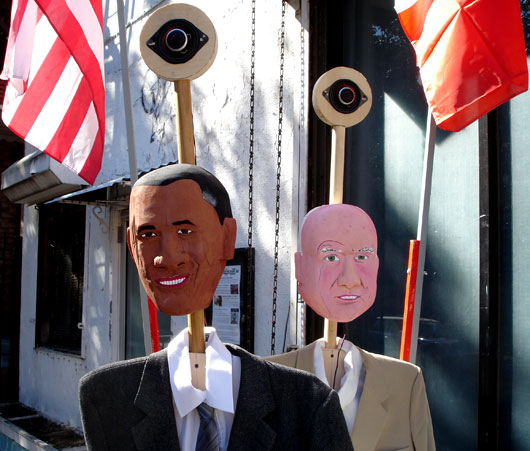
VOTEMOS.US an online initiative that questions how the 2008 United States Presidential Election would differ if all residents of the United States could vote, takes to the streets in the form of a voting cart by which participants may take the voice of either McCain or Obama as they make public a hypothetical vote for the 2008 U.S. Presidential Elections.
Catch the cart at Eyebeam during Open Studios on Saturday, October 18th, 3-6pm. Watch video of the cart traveling from Not an Alternative through Williamsburg to McCarren Park.

Special thanks to Jason Jones (cart fabrication), Charles Rittman (bust chiseling) and Not An Alternative for helping me realize the project.
McCain in coitus with Bush
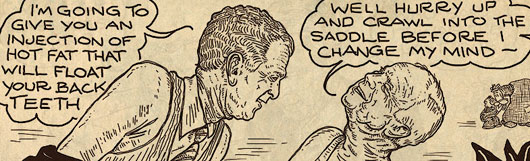
I discovered an over the top illustrated love story between George Bush and John McCain by artist Ethan Persoff. The title page states that the material is for adults only and it is in the vein of R. Crumb. So if you’re ready for some dirty humor following a convention of Republicans in denial, check out “The Adventures of Fuller Bush Man and John McCain in ‘Obliging Lady'”
I write Republicans in denial, because after watching the major speeches of the RNC, I was appalled at the rhetoric employed to try to put the blame of the state of this nation internally and externally on someone other than themselves. It was befuddling to hear the declarations that they will clean out Washington of corruption and establish a transparent government, when we’ve had eight years of a Republican presidency and they’ve had the majority in the both the House and Senate during the first seven years of this Republican White House! (Of course the denial is aided when the current Republican president and vice president are kept far away from the convention.)
Bad Art: Eliasson’s NYC Waterfalls
Generally, I blog art that I like and find inspiring, but every now and then when I find art really annoying and over the top, I can’t help but including it in this site and Olafur Eliasson’s NYC Waterfalls fall into the annoying and ridiculous of contemporary art.

Jerry Slatz gets it right when he states that “the waterfalls seem dinkier than you’d think… In addition, it’s obvious that these aren’t waterfalls at all; they’re just plumbing, tall metal scaffoldings with pipes pumping cascades of water off the top.” Then in the following paragraph of his NY Magazine review he waxes poetic, not so much about the Waterfalls, but how they enhance the NYC skyline. But the NYC skyline doesn’t need clunky$15.5 million waterfalls to enhance it!
The NYC Waterfalls strike me as a failed attempt at monumentalism and an example of the worst type of public art – public art that can not be enjoyed and experienced by people, it can only be stared at from a distance. Whenever I visit Chicago, I make a point of going to Millennium Park, the grand public arts work in downtown Chicago. Millennium Park has its own conflicts, but as I watch people interact with monumental contemporary works of art at the park, I see success because people are able to enjoy the work first hand. Children play in Plensa’s “Crown Fountain”, people stand within Kapoor’s giant bean and are mesmerized by the reflection and visual play. Of course Millennium Park is permanent, but the park presents exciting possibilities for public art at a monumental scale, whereas the Waterfalls presents a modernist throwback to public art.
People have compared the Waterfalls to Christo and Jeanne-Claude’s The Gates, but The Gates managed to transform Central Park at both the sweeping grand scale of the park as a whole as well as at the level of the individual pedestrian. Whereas the Waterfalls are not attractive, they merely appear as a lot of scaffolding with running water that shrinks below the scale of the city. It’s a shame that the Public Art Fund doesn’t take a more visionary approach to the possibilities of what public art might be.
A Sonic Election
As the U.S. Presidential Elections near, artists are preparing creative critiques and shedding light on alternate perspectives by utilizing every media vehicle available. Two online projects that combine sound and the social aspect of the web are Another Protest Song and Voices of America. Both projects rely on contributions from across the globe to establish an archive of audible dissent.
Valerie Tevere and Angel Nevarez have asked musicians, artists and song writers to contribute their contemporary protest songs. Another Protest Song questions “What does a 21st Century protest song sound like?” and seeks to establish an online archive of musical outcry today.
Voices of America a collaborative effort between Lee Azzarello, free103point9 and Sarah Kanouse will investigate the sound and reach of the US government broadcasting service Voice of America, heard on radio across the globe, but not in the United States. Voices of America asks contributors to upload recorded election coverage from over-the-air Voice of America stations to then be downloaded and remixed by anyone online. The site launch is immediately following the Democratic and Republican conventions, but the site is now open for participation.
Both projects rely upon the participation of the online masses to generate content that reflect nuanced elements of today’s political arena.
OS GEMEOS, “Too Far Too Close” at Deitch
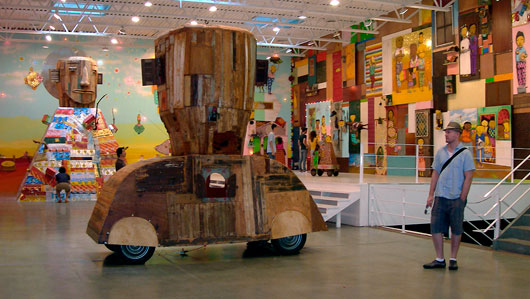
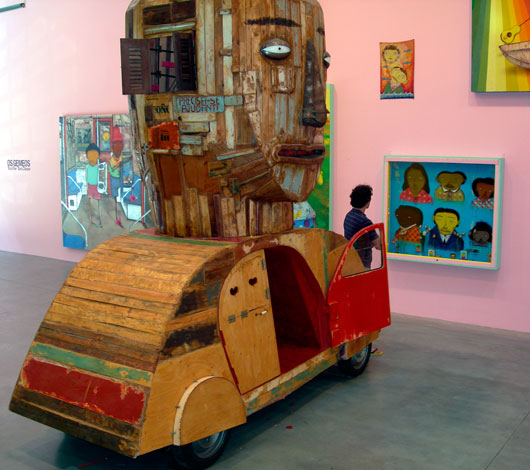
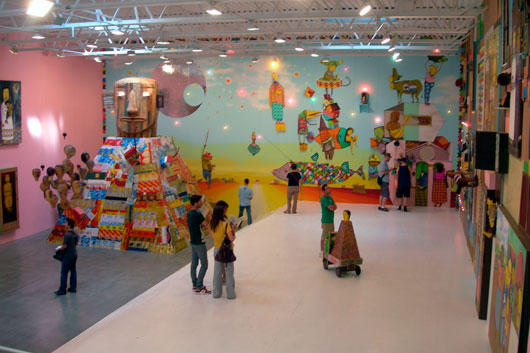
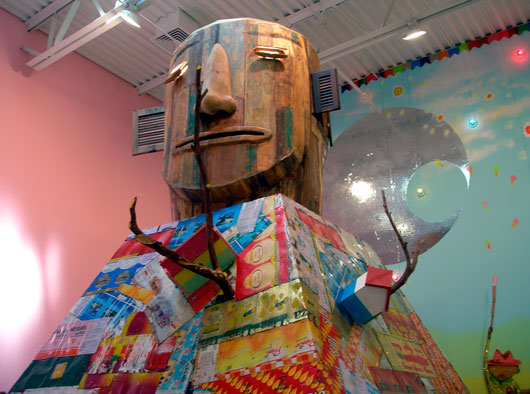
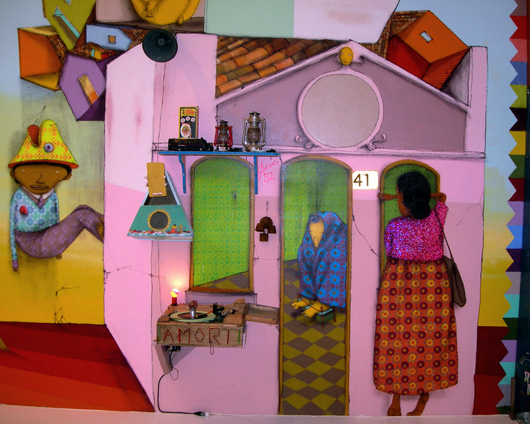
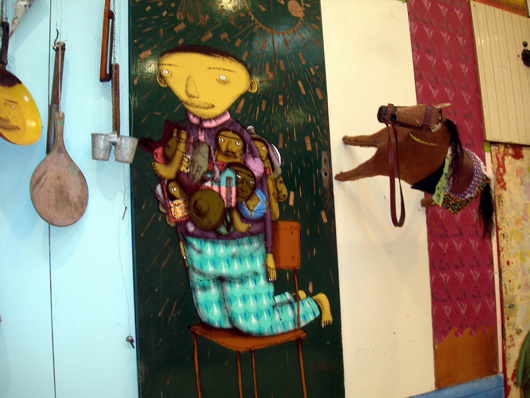
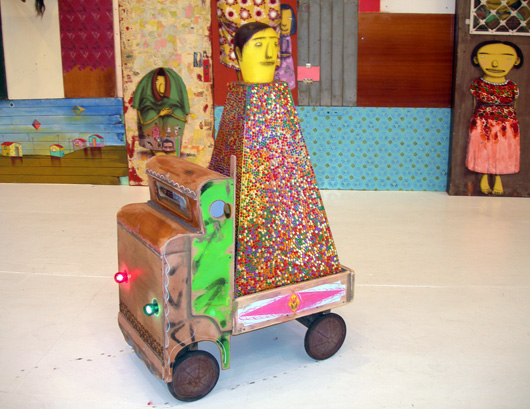
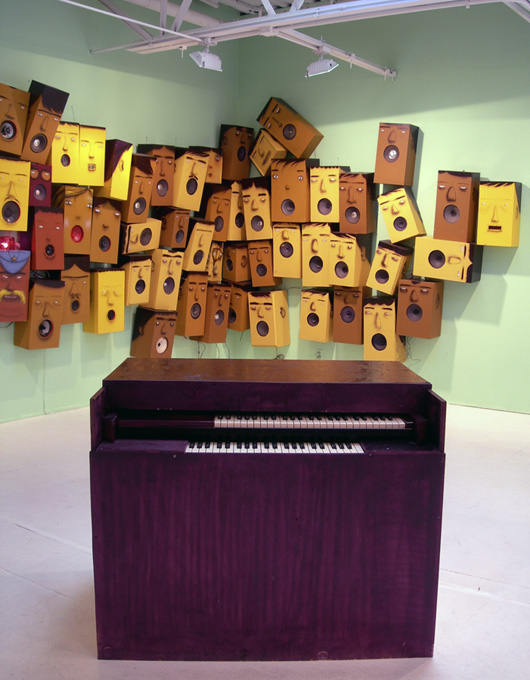
This past week, I happened to be running errands on Canal St. and decided to stop by Deitch to check out what was up and was wonderfully surprised by an incredible installation by the Brazilian twins that go by just that – Os Gemeos. I’ve been a fan of Gustavo and Otavio Pandolfo’s work for a while and it was just at the right time to walk into their installation, because it presented the sort of inspiration I’ve been in need of… Simply Latino, celebratory and brilliant. More documentation at SuperTouch.

Once You Step Outside the Reign of Aesthetic, the Work Is Only as Strong as the Subject
Pedro Lasch at Nasher Museum of Art, Durham, NC
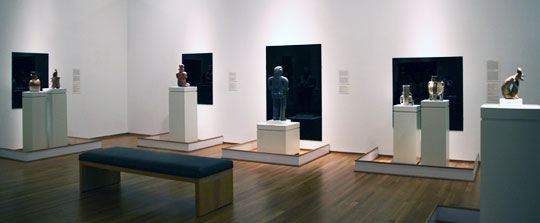
BLACK MIRROR / ESPEJO NEGRO: A Museum Installation by Pedro Lasch is one installation that I’d very much would like to see, unfortunately I doubt that I’ll be in Durham, North Carolina this year. Fortunately the press release that I received from Pedro represents the installation clearly enough to excite the imagination and leave a mental imprint.
Look carefully at the left side of the photograph below, from the black mirror a colonial Spanish face peers out to the indeginous idol and the viewer.
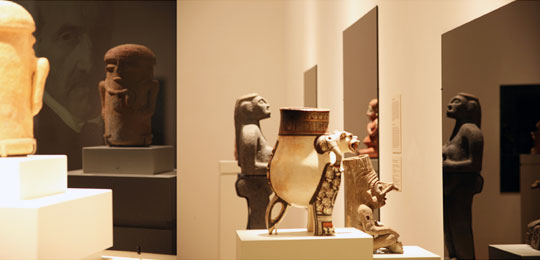
The pre-Columbian figures borrowed from the Nasher Museum collection have their backs turned to the museum audience as they peer into the black mirrors on the walls. Pedro Lasch describes the sculptures with their backs turned as “defiant”. Upon viewing the picture, I viewed them as defiant to the museum and museum goers who view these works out of context, stolen from their homes and delivered to static white walls and pedestals. The black mirror collapses the past and present with the embedded colonial portrait and the reflection of both the pre-Columbian figure and the viewer. However the exhibition is best described by Pedro, particularly as I haven’t seen the installation:
BLACK MIRROR/ESPEJO NEGRO: Artist Statement
Abstraction and Refusal
As we enter the room, black rectangular mirrors of different proportions dance in stark contrast to the white walls, calling attention to the structural aspects of the gallery. Facing each mirror, at different heights and depths, defiant pre-Columbian figures stand on pedestals, all of them turning their backs to the viewer. While their refusal may push us away, their reflections on the mirror pull us in. Even so, we find that it is impossible to see these figures’ faces without also encountering our own faces reflected in the same mirror. The dark flat surfaces of black glass transform images of sculptural bodies into ephemeral paintings, incorporating the viewer’s reflection, the environment and the ghostly images of yet another set of gazes, those of Spanish priests and conquistadores.
Mediation
The individual works that compose the overall sculptural installation are entitled _Black Mirror #2 through #12_, each pairing a Spanish painting of the Colonial period that emerges gradually from behind a dark sheet of glass with one or more pre-Columbian sculptures from different regions and periods. At the center we find _ Black Mirror #1_, the object that inspired the whole installation. It is an elegantly shaped obsidian disc from the museum’s permanent collection. I propose we use this black “rosetta stone” as a tool to decipher ancient Amerindian civilizations, as well as a window onto the wealth of contemporary indigenous civilizations and peoples across the American continent.Tezcatlipoca and the Obsidian Journey In pre-Columbian America, as in many other cultures, black mirrors were commonly used for divination, the art of knowing past and future events, and for necromancy, the art of communicating with the dead. The Aztecs directly associated obsidian with Tezcatlipoca, the deadly god of war, sorcery and sexual transgression. Threatened by similar associations with sorcery and deviance, Pope John XXII banned the use of mirrors for any religious purpose in 1318. Yet centuries later, obsidian plates of all shapes and sizes would be introduced into Christian altars across Spain and its colonies, eventually becoming the surface on which artists, including Spanish baroque master Bartolomé Esteban Murillo, would paint saints and virgins.
Through the Claude Glass and into the Age of Surveillance
The Spanish Colonial works appearing in this installation can be seen as early examples of two key modern and contemporary forms of representation that resemble the obsidian black mirror: the ever-present photographic camera and the _Claude Mirror _ of 18th-century Europe. Named for atmospheric painter Claude Loraine, the Claude Mirror was a portable, convex tinted glass or mirror, which painters and photographers used to create their pictures. This optical device marked a shift to a new period, when ritual and magic gave way to scientific illusionism and Colonialist expansion. We no longer use black mirrors to speak with the dead, or to fix a gaze on objects that may last a little longer than we will. Yet little black eyes still hover all around us in the form of cameras placed in many public buildings and outdoor spaces. These black mirrors still act as go-betweens between the present and the absent, the visible and the invisible, the colonizer and the colonized.
– _Pedro Lasch_
Kara Tanaka at Simon Preston Gallery
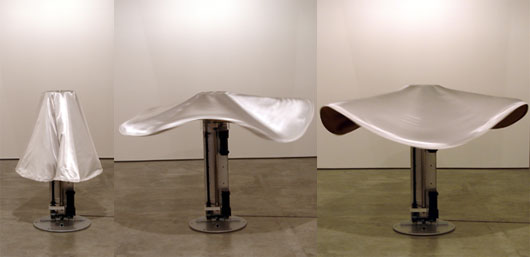
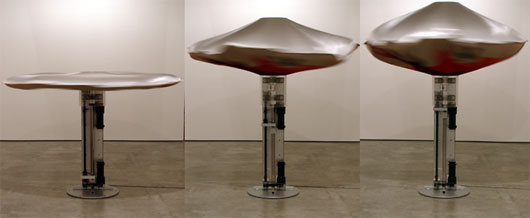
Kara Tanaka’s “Crushed by the Hammer of the Sun” is simply cool and mesmerizing. Thursday afternoon I had some time to kill in the Lower East Side, so I stepped into Simon Preston Gallery on Broome Street where there is currently a two-person show featuring Marco Rios and Kara Tanaka. I was immediately drawn to a silver spinning disc on an exposed mechanized pedestal at the back of the gallery.
The first gallery had a few sculptures by Marco Rios: a giant yellow level leaning against a wall, a little elphin blue man holding his knees sitting in a corner sculpted from the anti-depressant drug Paxil and small non-descript metal pieces on shelves. The sort of work one expects to see in a gallery representing young artists who have been influenced by the likes of Charles Ray and Tom Freidman, really not very interesting or exciting, because we are so familiar with it and know it is merely contemporary art, not much more than objects that will hopefully be bought and sold…
But the spinning disc at the rear of the gallery isn’t clearly such a thing. It is a kinetic object that requires one to spend time with it, study it, and wonder what it is. That is until it stops spinning and one discovers it is a silver fabric on the exterior and tan, brown and pink fabrics on the inside that only become apparent as the mechanisim lifts the spinning disc of fabric and seperates the exterior and interior layers into an oblong UFO like shape. The beauty of the work isn’t that it is kinetic, but rather the manner in which it all comes together – a simple silver fabric being spun into a disc that immediately makes one think of a UFO, the use of speed and spinning disc helps to mesmerize the viewer. It’s a poetic work that doesn’t fall short of its title “Crushed by the Hammer of the Sun” which implies a heroic narrative. Of course it helps to walk into the gallery while it is in mid-spin and the material and shape are transforming, and then I had to watch it a second time.