TRANSITIO_MX02 at Laboratorio Arte Alameda
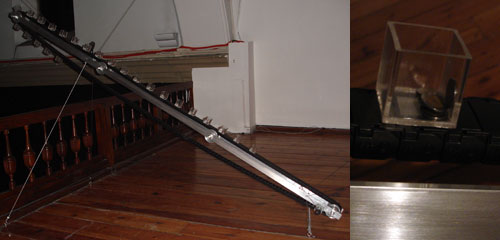
Mario de Vega presents a machine that drops coins equivalent to the minimum wage of the various states of Mexico.
As a conceptual premise, TRANSITIO seeks to question what is community, how is it constructed as a social concept and as physical reality. The museum Laboratorio Arte Alameda houses two curatorial projects Im_polis…(Place of Relation) curated by Ale de la Puente, Rogelio Sosa, Ivan Abreu and Karla Jasso and (dis)COOMmunities curated by Laboratorio 060 both are part of TRANSITIO. One other curatorial grouping Free Synthesis is primarily located at the Center of the Image. The three curatorial endeavors began nearly a year ago as Jose Luis Barrios lead a seminar that reconsidered the modes of art exhibition. As the seminar proceeded the participants formed curatorial groupings with varying perspectives and TRANSITIO began to take shape.
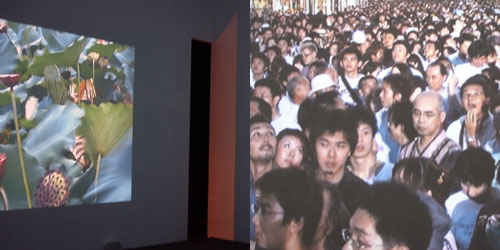
“Bright Future Ahead” (2006) by Jan Verbeek is a four-channel video installation in a white cube. The videos have been shot in Japan and present sequences that toggle between nature and saturated urban spaces.
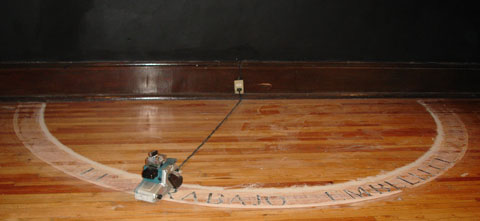
The phrase “El Trabajo Embellece” (Labor Beautifies) by Jose Marti is superimposed upon the floor of the museum and a sander activated by museum visitors erases the phrase from the floor over time. This is a work by the Mexican artist Gilberto Esparza.
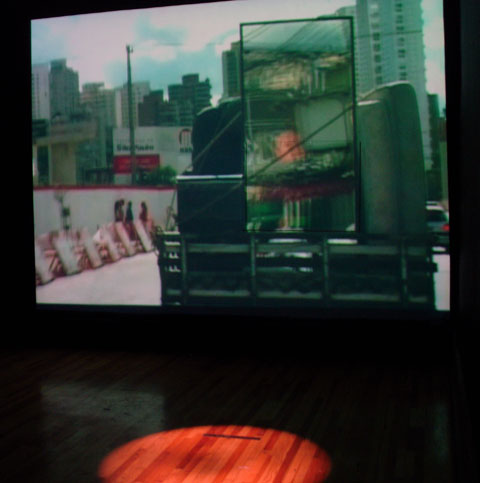
“Moving” (2007) Raquel Kogan is a black cube video installation. The video projected onto one wall follows an open air moving truck, filled with home goods – mattresses, a television, other furniture and at the very rear of the truck a mirror. The truck drives through the streets of Sao Paolo. A few feet before the mirror is a spot light intended for the viewer to step into and when one does, the viewer’s image appears on the mirror.
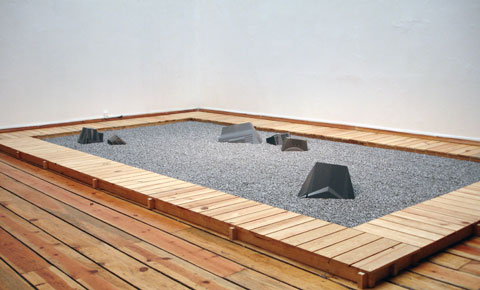
Jaime Ruiz Otis has created a Zen Garden in a traditional manner, but with non-traditional materials. He built a rake to lay down the design on to shredded silicon that composes the ground of the zen garden. amongst the gray ground of silicon are partly burried televisions. The zen garden presents a reflection of the waste generated by today’s popular technologies.
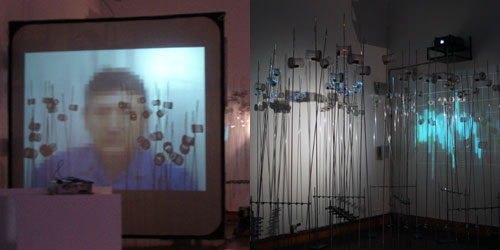
Australian sound artist and sculptor Nigel Helyer (a.k.a. Dr Sonique) has created a visually stricking installation in which a series of structures holding crickets are located between two projections, one that shows a pixelated video of a professor lecturing on crickets and the second a visualization of the audio as 200 crickets listen to the lecture. The installation is titled “Host” (2002).
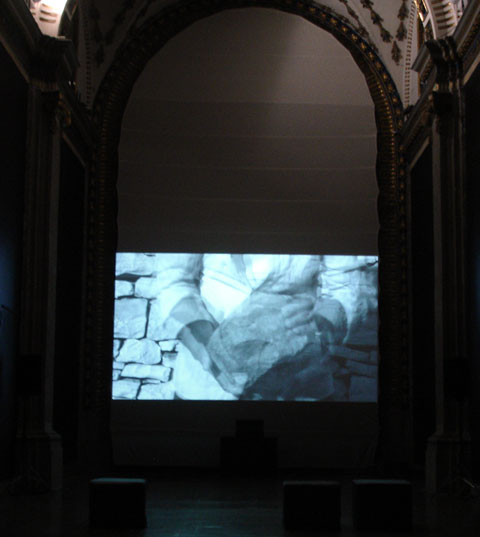
Toni Mestrovic has created a hypnotizing video loop with surround sound. The video consists of three superimposed sequences of a man’s hands forming a stone that will be part of his home. The three video sequences have a slight time difference to create a layered effect, but for a moment, all three sequences converge to create one single video image. The hands belong to Toni’s father who is currently reconstructing his childhood home. It is a stone home built in an ancient manner, without mortar or cement. Each stone is shaped by his hands to be placed as part of the structure. The sound is not clearly defined, but it suggests the sound of the hands against the rock as it moves throughout the side naive’s interior.
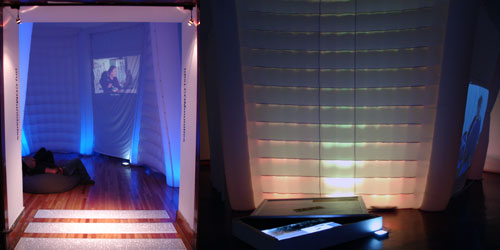
The designer and architect Jorge Perez designed an inflatable structure to serve as a hub for the various curated projects of (dis)COMmunities, since many of the projects are occurring on the street or between locations. The hub is also serving as a temporary meeting place for various organizations.
Other works include a beautifully shot video of a businessman with a briefcase riding a bull and eventually loosing all his documents as the briefcase flies open by Gonzalo Lebrija. A sound installation titled “The Sound of Mercado Libre” by Ubermorgen.com. A gorgeous video that only presents information – adds, billboards, icons, street signals in the streets of a European city, all else is black. The work is titled “Kapitaal” by Studio Smack.
TRANSITIO_MX02, CENART Opening
Friday October 12th was the big kick off for TRANSITIO_MX02, International Festival of Electronic Arts and Video taking place throughout Mexico City. Comprised of three curatorial projects – Free Synthesis, (dis)COMmunities and IM-POLIS, an open call competition, electronic music concerts, artist workshops and a conference, the festival is taking place at three locations: the National Center for the Arts (CENART), Laboratorio Arte-Alameda and Centro de la Imagen.
The initial opening and concert was at CENART which is housing the exhibition of finalists from the open call for the TRANSITIO prize. Many of the finalists were represented by video documentation such as Usman Haque’s “Open Burble.” There was a beautifully shot three panel video projection by Erik Olofsen titled “Drives”. Below are a few projects installed in the Art Center’s gallery.
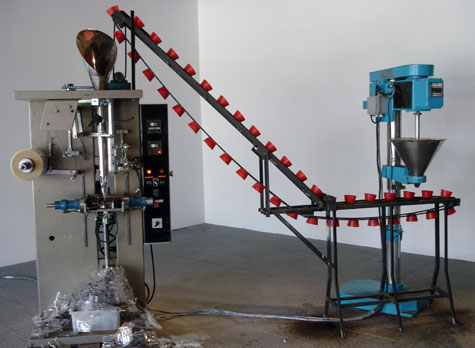
My favorite project which is visually striking, conceptually intriguing and offers free packaged Mexican dirt is “Tierra y Libertad” (Earth and Liberty) (2007) by Ivan Puig based in Mexico. Puig has constructed a machine that deposits dirt taken from the base of CENARTS into red plastic cups that are then deposited into plastic bags that are sealed and stamped for the visitors to take.
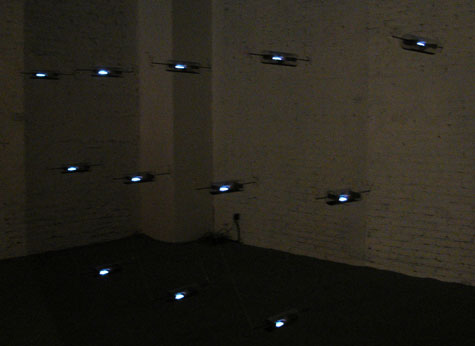
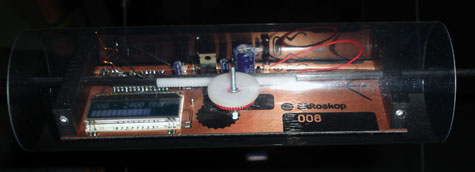
SARoskop (2007) by Karin Lingnau and Martin Hesselmeier based in Cologne visualizes the electromagnetic waves in the immediate area. If one uses their cell phone near the grid-like installation SARoskop, the objects come alive, moving horizontally on a rail that each component is mounted on and displaying the frequency of the call.
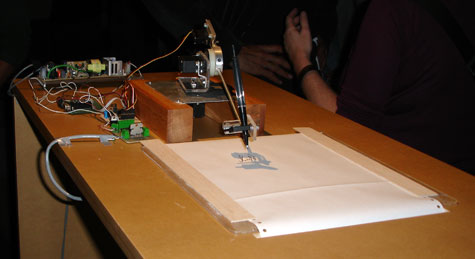
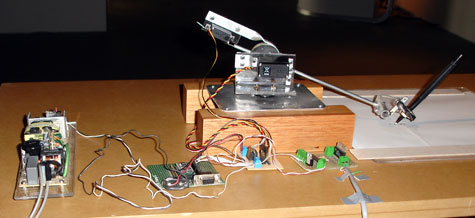
A second physical computing project installed at the exhibition is VEHICLE (2007) by Gerardo GarcÃa de la Garza, a robotic arm that duplicates Joseph Beuys signature triggered by visitors who approach the work. Visitors are free to take a signed sheet.
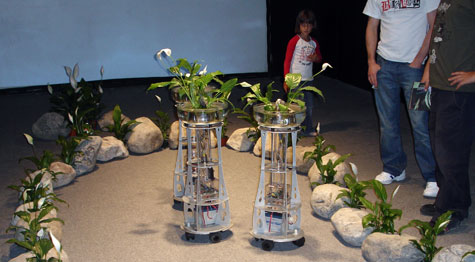
Separate from the finalists’ exhibition, in its own gallery at CENART is installed Ken Rinaldo’s “Augmented Fish Reality”, a well travelled installation in which Siamese Fighting fish drive the robotic pedestals that the bowls sit on.
TRANSITIO continues through October 20th, over the next week I’ll continue to document other pieces of this giant festival, including the keynote presentation by Gunalan Nadarajan, the curated exhibitions and as many of the panels that I can attend while executing my own commission in the park Alameda Central.
Carreta Nagua Siglo 21, day 5
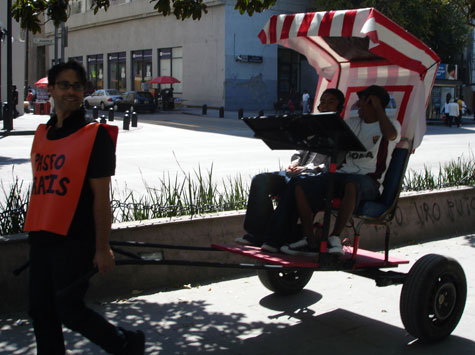
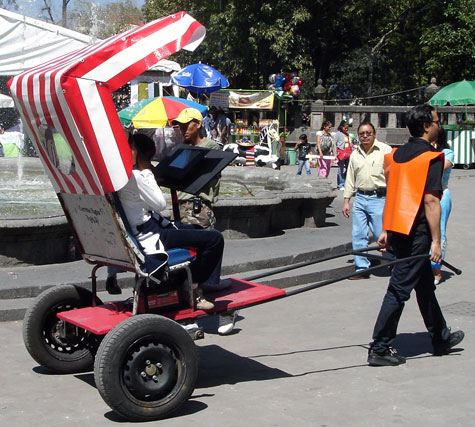
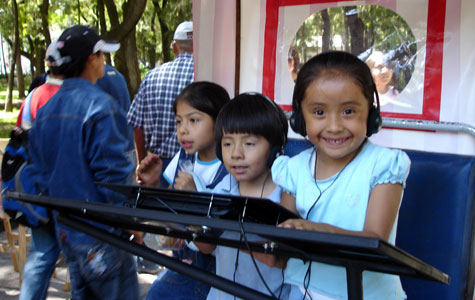
El Parque Alameda Central is filled with people on Sundays. Musicians, merchants, families, tourists and this Sunday was a beautiful clear day, perfect for a nice tour through the park on a rickshaw. Most people questioned the fact that the ride would be free, but once a few people were convinced many more waited to be taken for a ride and watch the animation. People seemed to enjoy the animated narrative that featured El Chapulin Colorado and Ultraman discussing personal changes due to migration.
Carreta Nagua Siglo 21, day 4
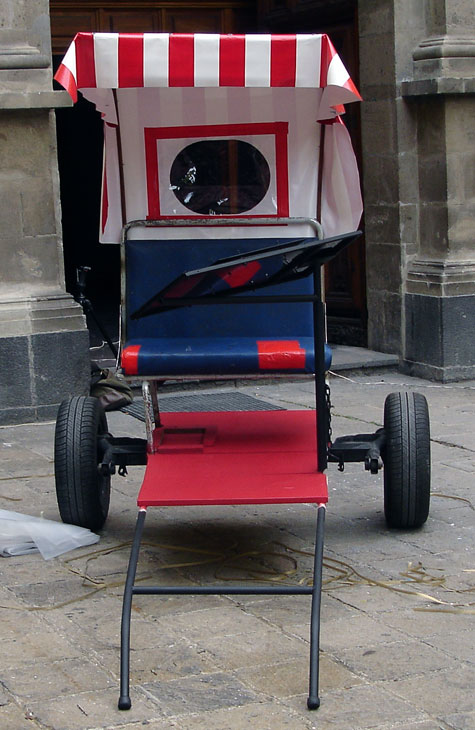
The cart is finalized with rooftop, panel for the display, painted and ready to take people on tours of the park.
Carreta Nagua Siglo 21, day 3
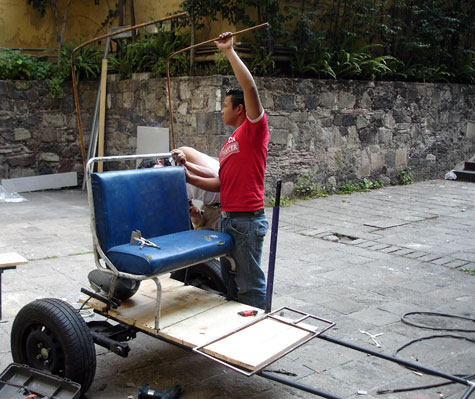
Putting the final pieces of the frame work of the cart, before painting and adding all the details.
Carreta Nagua Siglo 21, day 2
I had a young crew of three boys to help me assemble the cart through the weekend. Saturday morning I took a trip with their boss, a Spaniard named Hector who runs a fabrication company that primarily does exhibition production for large media companies such as Sony, but prefers to do production for cultural institutions, they just don’t pay the bills. We drove to his shop with a couple of his employees to gather tools and materials. Returned to Laboratorio Arte-Alameda and immediately got to work. It was a late start and I only had the three guys that day and Sunday. By the late afternoon the cart began to take shape. We completed the basic structure, installed the bus chair and resolved a few questions. In the early evening it began to poor so we stopped to continue on Sunday.
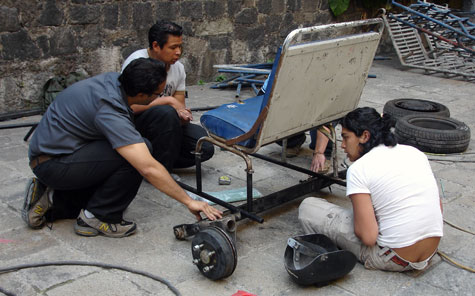
Discussing the joining of the axle to the steel tubes that would make the primary structure.
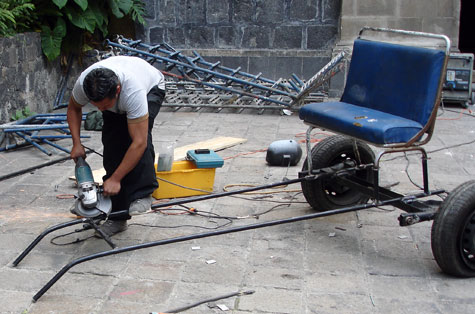
Cleaning up the welds.
Carreta Nagua Siglo 21, day 1
Friday, October 5th was the first day on getting started in assembling the physical component of my TRANSITIO commission for “impolis”, one of a series of curatorial components that make up TRANSITIO_MX02, the second installment of this new media festival in Mexico City.
I’m building a rickshaw that will tour people around a park in the historical center of Mexico City, Parque Alameda. As people take a ride on the rickshaw that I will pull, they will watch an animation that I’ve been creating over the last few months. Carreta Nagua is an old folk tale from Nicaragua, tale generally told to children when they refuse to go to sleep, because it’s a wagon (carreta) driven by death and pulled by two skeletal oxen, it makes a great deal of noise, as if chains were been dragged along the ground as it makes it way. When the Carreta Nagua arrives at ones home, the person is sure to die. It’s assumed that the tale, a very old tale shared amongst the indeginous people of Nicaragua, but also having many parallels throughout Latin America, is believed to have been established due to the slave carts driven by the Spaniards to take slaves to the mines. People taken by the carts would disappear, only to be seen again as corpses. The Spanish would take indeginous people to the mines to work, where they would wear away to die and be taken as corpses for burial. When indeginous people heard a cart, they would hide, the cart became a symbol of death.
The animation featured on the cart, on a panel that sits in front of the passenger is based on my parents. They left Nicaragua over 40 years ago, to work and establish a family and to give their children greater possibilities. Now they are returning to Nicaragua, but it’s an entirely different place than the one that they left. “La Carreta Nagua” is an allegory for the translocation of people, the leaving of ones culture, extended family, language – for greater means or opportunities / for economic reasons in a pancapitalist era. This is the personal or subjective or individual portion of globalization, not the corporate form of globalization, but the mass migration of populations due to highly subjective decisions by individuals.
So Friday was day one, when I was taken by Juan and Israel to “deshuesadores” – one translation might be skeleton cleaners, but really auto wreck dumps. The rickshaw needs an axle, tires, seats, a steel frame… all parts that can be found at an auto dump. I’d been concerned at how all this would come together, but it went smoother than I could have imagined. At our second stop we acquired nearly all the primary parts and at a fraction of the price that the curators had set aside for the project. One of my goals was to assemble this piece entirely from recycled parts and not to use new materials, so far so good. Here are a few shots documenting day one.
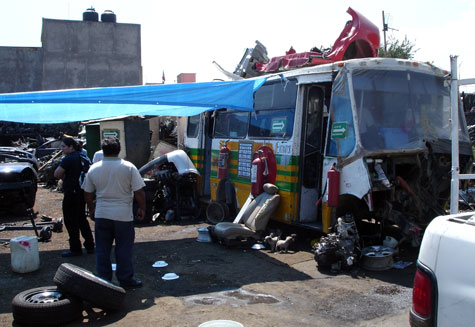
This auto wreck site revitalized an old bus as its office. To the right is the office and beyond is surplus of old and new cars and parts that can no longer function as designed.
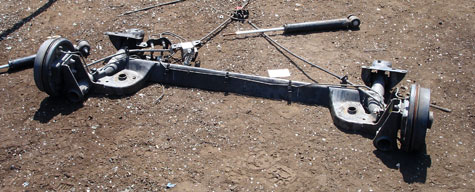
I showed a kid working the site a few drawings, explained what we were building and asked for specific parts and he pulled out an ideal axle, a unit nearly ready to go that would be wide enough to seat two above. We bartered down the price by leaving the shocks that were on the axle. Every single piece has a value.
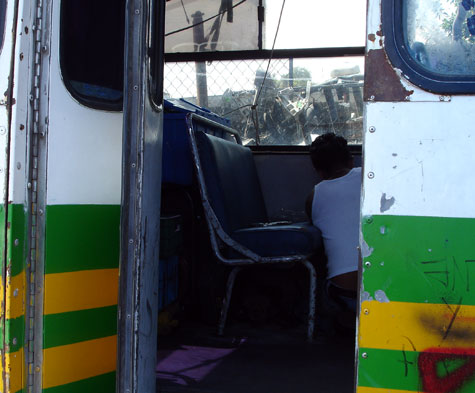
After we asked for seats, he showed us a few car seats, mostly bucket seats from recent cars, but they weren’t what I was looking for. I looked into the office and saw the bus seat near the backdoor and told the guys that were taking me around that that was what I was interested in and they said well, let them know. I did, they gave us a price, we haggled and we got it. Everything is for sale, event sections from the business office.
Their tire prices seemed high, so our driver suggested that we try a few tire repair places, such as the one below. Set up on a corner, one can pick up a new tire on the fly, such as the one below
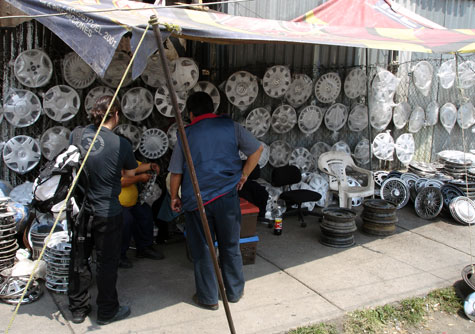
After a day that started with a long and crowded metro ride and continued into several hours of driving around Mexico City in increasingly terrific traffic and haggling for car parts, I was taken by Antonio, the exhibition administrator who took car of all the public art permits to a very old taco place in the town center. Then we had a couple tequilas on his deck overlooking Mexico City’s downtown.
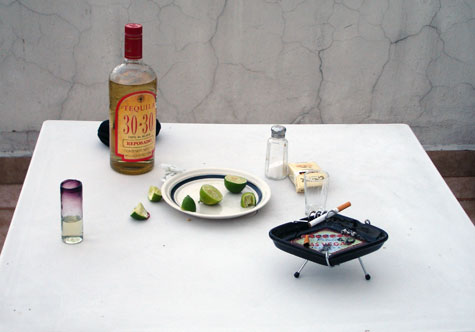
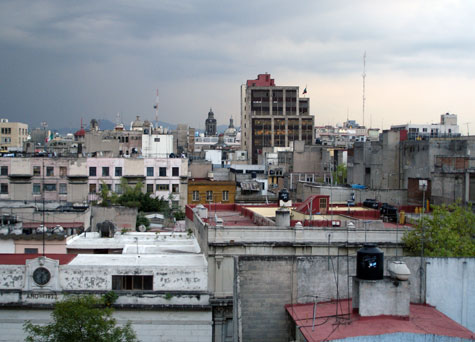
A view of Mexico City’s historical downtown from a 5th story deck
Street Vendors in Mexico City
I arrived this afternoon to Mexico City to complete a commission for Transitio_MX02 Festival Internacional de Artes Electronicas y Video that kicks off October 12th for a week of exhibitions, panel discussions, screenings, performances, music… After getting a tour of the exhibition space that will be my home base Laboratorio Arte-Alameda and meeting a few of the coordinators, I went for a walk through the historical center of Mexico City. It’s been 12 years since I was last in Mexico City and the sidewalks seem even more crowded with street vendors than I remember. The street vendors in the historical center are a powerful force. When the civil administration has tried to get them of the sidewalks, the street vendors have united to present a powerful lobbying force. Today they are an institution that is not so much of an informal sector as a politically powerful entity that pays an undocumented tax to city representatives. It’s a gamble that some 65 thousand people take to set up a small business.
This evening, I went for a stroll at 7pm, just as many of the vendors are ending their day. The steel frame of their stores are left empty, all goods are packed onto hand carts and pushed along the streets to secure outdoor parking lots where they pay to store their goods. The book stores look like large lockers that collapse into themselves and are padlocked. The current city administration is trying very hard to clean the street of its “ambulantes” or street vendors, it’s succeeded in some blocks only to see them relocate in other blocks that already have vendors, making it very difficult for pedestrians to make their way. The city in general is split, many of the people buy their goods from the street vendors at a portion of the price that they pay at a supermarket, so the street vendors become the market of choice. Whereas others, perhaps with greater means find them to be a nuisance.
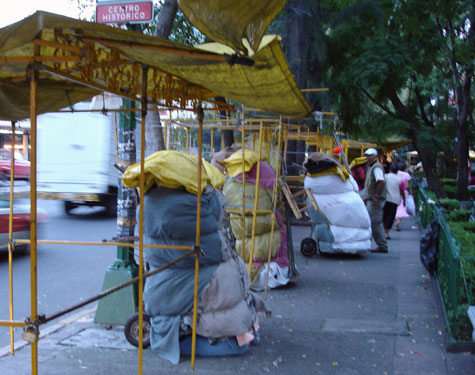
The store is packed and ready to be pushed to a secure parking lot for overnight storage. The frames remain, a permanent fixture of Mexico City’s Historic Center.
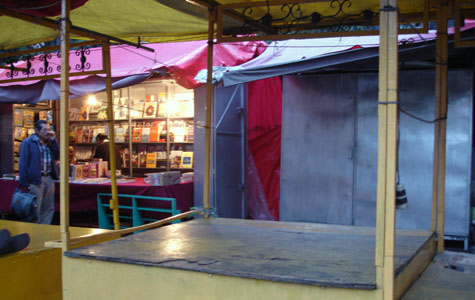
One book store remains open when most have been shut and locked.
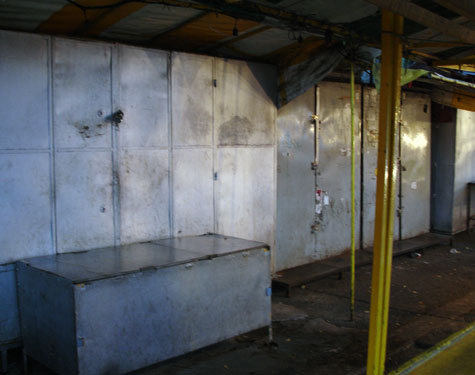
Behind the locked doors are shelves of books, magazines, CDs, DVDs…
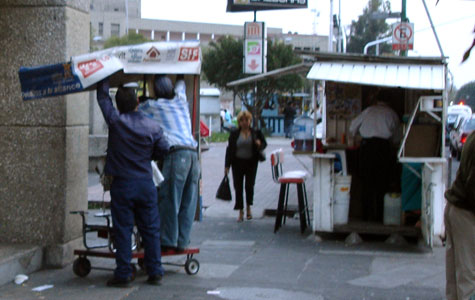
By 7pm the mobile shoe shinning units are shutting down and being prepared for storage.
Raymond Pettibon at Zwirner
As an artist and professor, I try to make the rounds to the Chelsea galleries with each new round of exhibitions. However, over the years, I’ve narrowed the number of galleries that I stop through, because there are so many and for the most part I think that most of the work I see in Chelsea is really bad.
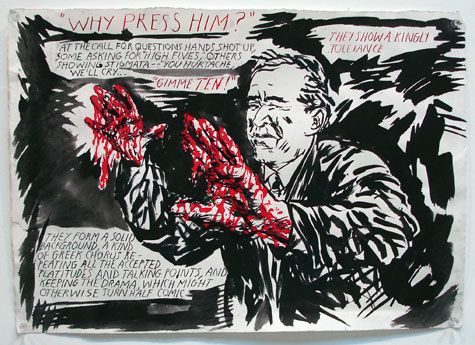
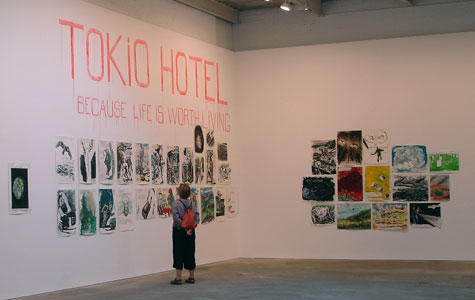
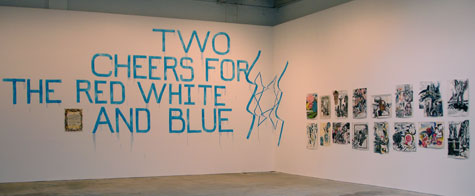
One of the galleries that I always try to stop by is David Zwirner, because the work presented there usually reflects my flavor for an ideal combination of content and execution. I generally see compelling work that is well done. And the current exhibition by Raymond Pettibon, “The Big Picture” is a great example of this.
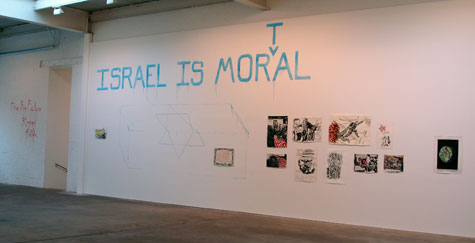
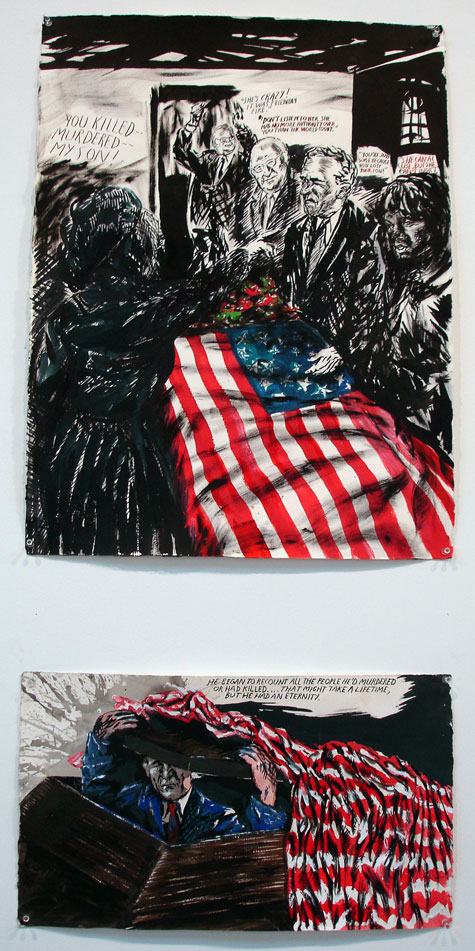
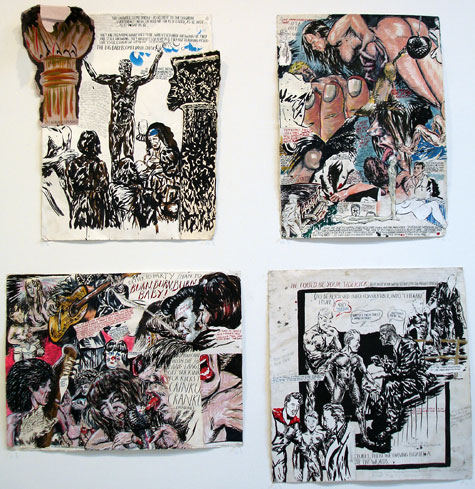
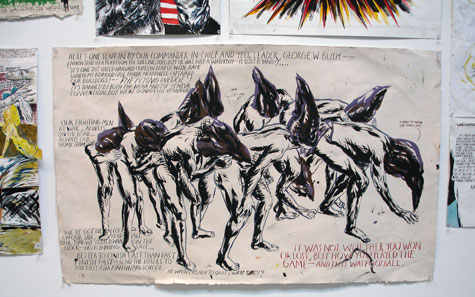
Pettibon’s drawings are beautiful and exciting. They are the sort of drawings that make one want to draw, because they are full of energy, they tell a story, they pull the viewer in and they are topical. Through his drawings, Pettibon lays it out, this is the world that we live in and it’s fucked up.
On the other hand, Zwirner also shows bad stuff. Step out of Pettibon’s Big Picture, down the hall way to Chris Ofili and you’ll see Modernist junk. Incredibly boring work with a precious price tag.
Presentity by Kabir Carter
Presentity by Kabir Carter was one of the most unique public art experiences that I’ve had in a very long time. This is primarily due to its honesty and subtleness. The project did not involve any spectacle, rather it was a highly private experience carried out in tourist center filled with activity.
A few weeks before the dates of the performance, Kabir emailed an invitation to be audience to Presentity. Eager to listen to Kabir’s work and spend time with the sound artist, I replied and he wrote back with a time and date and that I would receive a text with the exact location the day of the performance. It was all a bit mysterious.
On Saturday August 18th, I received the address – the back stairs of City Hall on Chambers. That afternoon I sat and waited for Kabir as firetrucks rushed by to the Deutsch Bank building where a fire exploded. There was one other guy who showed up and looked like an artist. Kabir showed up carrying three walki-talkis, he introduced us and we began to walk.
On Chambers we walked east, turned the corner at Centre Street and entered a very old subway elevator. We rode the elevator up and down twice, the first time with one other person, the second time, only the three of us and the performance began. Kabir manipulated the walki-talkis to create the electronic sound performance, we merely walked with him and listened as carefully as possible. We exited the elevator below ground, entered the subway station, walked through the tunnels, up the stairs and back onto Centre Street, walking adjacent to City Hall, listening carefully. Then crossed the street toward Pace University. Bent down to the ground to listen to the sounds resonating within the cavernous space below a steel grate.
Again we entered the subway, this time via a desolate subway entrance at the corner of Pace University, we walked through a long, empty subway tunnel. We exited the subway and the performance ended.
The walk and performance were a delicate intervention upon the City Hall area of New York City, I call it delicate because it was comprised of three individuals focused upon careful listening in a saturated space where focus is difficult to achieve.
I felt that the sound performance began a bit awkwardly, as if Kabir needed a bit of time to catch his rhythm. However the elevator was a highly successful tool for spatial transfer… I’m not sure how to put this. The elevator was very successful in creating the sensation that we were being taken to a different place, to a site within a site… to our own place, a private space shared between us three individuals but located within the City Hall Park area.
At first the most difficult element personally was negotiating between getting out of the way of pedestrian traffic and listening to the performance. But as we continued, the listening took presedence over the concern of allowing pedestrians by. Also as the performance continued the sound began to coalesce, there was meat to it, it sounded as a concert or performance and not merely noise trying to find its language.