March for Peace, NYC 29 April 2006
April 30, 2006
As pointless as it seems with an untouchable Bush Administration, the protest march was lively and huge!
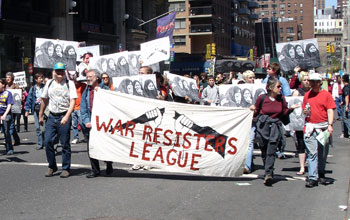

Communism alive and young in the U.S.

Considering an MFA
April 14, 2006
I’m currently teaching the senior BFA course leading to the students’ final exhibition. Most of the semester has been dedicated to professional development – resume building, press release, cover letters, fund raising, residencies… Last Wedensday however we discussed graduate school, as many of the students are interested in persuing an MFA. So I assemebled a presentation/discussion that I think anyone considering grad school might find helpful.
After discussing their personal interests in attending grad school, I pointed out the US News Ranking for Graduate Schools that they do every four years:
http://www.usnews.com/usnews/edu/grad/rankings/arts/artsindex_brief.php
http://www.usnews.com/usnews/edu/grad/tools/index_brief.php
Then I entered into my presentation/discussion based on personal experience:
Thinking About Grad School
It is helpful to consider Art in parallel to business or other professional areas in the sense that there are any number of ways of approaching a career in the Arts. Here are a few scenarios to consider to help you along in your decision process:
Location versus Program:Â “Do I go to a city with plenty of art and culture where I can use school to begin networking and launch me into an arts career in that city or do I go to a place where there may be less networking and the arts community may be smaller, but where I may have more time and space to focus and work?”
There are great programs where you will be able to focus, have a strong community with faculty and peers but are located in small cities, college towns or isolated rural areas. OR you may decide that being in a major city with a strong and diverse arts community comprised of a gallery district, several non-profits and available grants for artists is where you would like to go to grad school in order to begin to establish a lasting network, this primarily means schools in or near New York City or Los Angeles. To use graduate school as an introduction to the art world on a national or international scope is amongst the primary reasons that people choose schools in or near NYC and LA as many of the faculty may be represented by galleries in these cities and can help introduce one to the galleries. This of course can be particularly important to artists hoping to achieve an independent studio practice maintained by the sales of one’s work. This question may point to differences between a school that is gallery oriented versus teaching oriented.
Theory versus Practice focused programs:Â “Do I enjoy a research oriented practice informed by an understanding of cultural theory or do I prefer to jump right into the materials and allow the process to define the work?”
These two certainly are not mutually exclusive and less so as post-modernity is entirely indoctrinated into art instruction. However some schools will offer a strong theoretical underpinning to help develop the conceptual strength of your work and put less emphasis in technical instruction. These schools tend to be less conventional, have adopted a post-modern approach to art making and have little interest in craft. Here is an example of a description by/of this type of program:
This interdisciplinary program prepares artists of all genres—film and video, painting, performance and installation and sculpture—to successfully enter the contemporary art arena. A significant proportion of its alumni have achieved international and national reputations.
(Art Center College of Design, MFA description)
More traditional programs divide their areas by medium – one must apply to painting, or sculpture, or photography, etc. These schools may put a greater focus on technical skills and the development of one’s chosen craft and less emphasis on theoretical and conceptual background.
Strong craft oriented programs: Cranbrook Academy of Art, Michigan – http://www.cranbrookart.edu/
Alfred University
Where would you like to situate yourself in the arts:
Do you envision yourself as an artist working in a creative field with a company, such as a design firm, an ad and publicity company, an animation or film house…?
Do you envision yourself as an independent artist with a personal studio?
Would you seek to establish a relationship with a gallery?
Would you seek a teaching position to split your time between teaching and studio work?
Would you seek to maintain a studio through freelance work…?
Would you prefer to establish yourself as a regional artist with an emphasis in       establishing roots in a specific community?
Would you prefer to establish international credentials?
Would you prefer a studio practice versus a site specific practice versus a community       based practice?
Are you an object maker versus a time-based artist (performance, electronic arts)?
Check out real estate cost in the area
Financial Reality
The point of graduate school is to seriously focus in your work as an artist, without the dilemma and distraction of a full-time job. Consider grad school your full-time job, if you are unwilling to do so, it’s most likely not worth your money or time to attend a graduate school in Fine Arts. Look for programs that offer generous funding and positions as teacher’s assistant.
- Personal Suggestions:
- Take time off from school to test your dedication and perseverance – will you continue producing work without the framework of school?
- Be willing to live minimally or simply in order to give yourself time to continue developing your work without the strain of a full-time job.
- When it comes to applying to grad school ‚Äì research the faculty at the school, look at the work they have produced, look at the work of the current grad students, find information on the facilities, does the school provide generous funding for their graduate students, make an appointment to visit the school if possible, and of course request all their materials.
- Go to the program that offers you the most money, avoid debt if possible.
- With or without graduate school, a career in the arts requires a great deal of perseverance, dedication, and patience. It is important to establish sustainable systems for your work and yourself.
- It is useful to create for yourself a three year plan: where would you like to be in three years, what do you need to accomplish now to get to that point? After the first three years, evaluate where you are and your personal satisfaction/happiness/accomplishments and establish a new three-year program. Eventually the three-year plan may become a five-year plan.
Noteworthy Programs in the United States
The two “art centers”:
New York
Columbia University
City University of New York Hunter
School of Visual Arts (SVA)
Pratt Institute
Bard College, http://www.bard.edu/mfa/
Yale University
Rhode Island School of Design
NYU
Parsons
Los Angeles
University of California in Los Angeles (UCLA)
Art Institute
California Institute of the Arts
Art Center College of Design
University of Southern California (film)
Cities that are considered more “regional”:
Chicago
The Art Institute of Chicago
University of Chicago
San Francisco
San Francisco Art Institute
California College of the Arts
Mills College
San Jose State
San Francisco State
San Diego
University of California at San Diego
Boston
MIT
School of the Museum of Fine Arts
Minneapolis
Minneapolis College of Art and Design
Philadelphia
Pennsylvania Academy of the Fine Arts
Tyler School of Art
Temple University (Film and Media Arts)
The University of the Arts
University of Pennsylvania
Drexel University (digital media)
Pittsburgh
Carnegie Mellon University
Seattle
University of Washington
Smaller and rural areas:
Ames, Iowa
University of Iowa
Richmond, Virginia
Virginia Commonwealth University
Vermont College, Vermont Studio Center
Alternative Schools – meet only during the summer or limited periods
Bard (very hot!)
http://www.bard.edu/academics/programs/
Vermont College
http://www.tui.edu/current/ma/mfav/
Whitney Museum Independent Study Program, New York City (no diploma)
Schools with traditionally strong gallery associations
Yale
UCLA
Columbia
RISD
Bard
Schools considered strong for teaching
Carnegie Mellon University
Chicago Art Institute
UCSD
Post-Baccalaureate Art Programs
The Art Institute of Chicago
Maryland Institute College of Art (MICA)
http://www.mica.edu/PROGRAMS/postbac/
University of the Arts (in crafts)
Programs in Digital / Experimental Media and the Cultural Study of New Media
Film and Communication Studies Programs in Canada / Programmes de cinéma et communication au Canada
http://www.film.queensu.ca/FSAC/Schools.html
University of California at San Diego, Visual Arts
http://visarts.ucsd.edu/
Rensselaer Polytechnic Institute, Electronic Arts
http://www.arts.rpi.edu/index02.php
San Francisco State University, Conceptual Information Arts (CIA) Program
http://userwww.sfsu.edu/%7Einfoarts/
School of the Art Institute of Chicago, Art & Technology Studies
http://www.artic.edu/saic/programs/depts/graduate/ats.html
UC Irvine – ACE, Arts, Computation, Engineering
http://www.arts.uci.edu/article.php?nav_id=29&nav=29
http://www.ace.uci.edu/
Georgia Tech
School of Literature, Communication, and Culture
http://www.lcc.gatech.edu/index.html
Graphics, Visualization, and Usability (GVU) Center
http://www.cc.gatech.edu/gvu/gvutop.html
Carnegie Mellon University
Human-Computer Interaction Institute
http://www.hcii.cmu.edu/
Art Department
http://artserver.cfa.cmu.edu:8080/
Mass Institute of Technology (MIT)
the Media Lab
http://www.media.mit.edu/
Art Department
University at Buffalo
Media Studies Department
http://mediastudy.buffalo.edu/
University of Iowa
Department of Cinema & Comparative Literature
http://www.uiowa.edu/%7Ecomplit/
Mixed Signals by Sabrina Jones

March 05, 2006
I’m often dismayed by the realities of military recruitment. Recruiter’s thrive on young kids, with few options afterall they have quotas to meet. Finally, a friend lead me to a great resource that I can print, copy and distribute to kids:
“Mixed Signals – a counter-recruitment tool in comic book form -is now available for use in activism, outreach, counseling, education, starting conversations and saving lives.
16 pages, black & white. Suggested donation: $2 per copy.
To Order Copies: Contact sabjonze@yahoo.com with your address and how you’ll use them.
If you are a no-budget group – we can send you some free copies, otherwise, please contribute what you can to keep this thing rolling. We’re hoping to raise funds to print it with color covers (any leads?) but for now, let’s get the message out!”
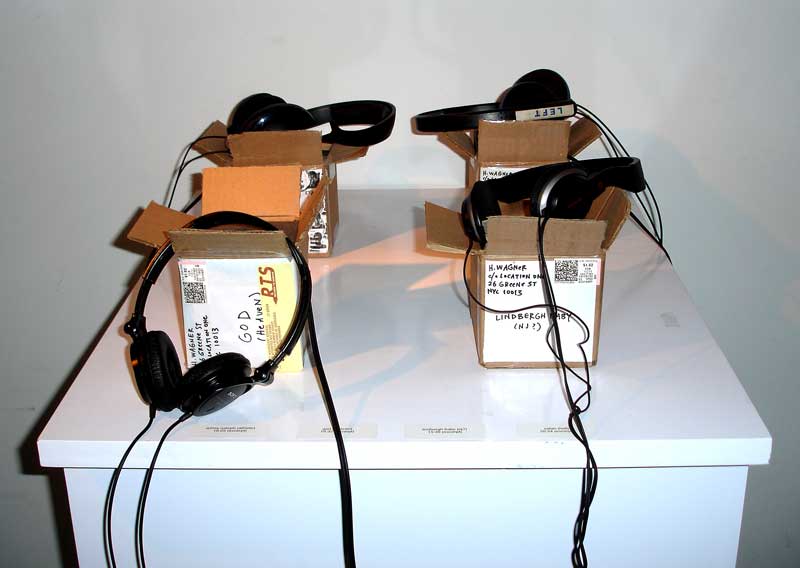
Heather Wagner, “Attempted – Not Known”
February 28, 2006
“A voice-activated recorder is sent through the mail to impossible addresses and then returned to sender with acoustic doucmentation of its journey. Postal workers singing and gossiping, the creak and bang of a mailbox chute opening and closing…? Or, maybe God and Baby Lindbergh have handlers who reject suspicious packages and return them unopened, and we are privy to their secret celestial conversations. Personally, I like to think it’s the latter.” The piece was on exhibit at Location One last fall.
Re-Learn You ABCs
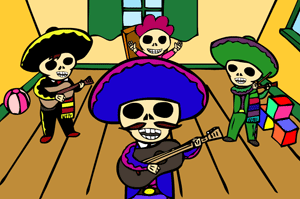
Artist John Jota Leaños recontextualizes our good’ol ABC song to today’s dark realities. In a time when it’s hard for anyone to live in ignorant bliss of the amount of conflict and death that humanity has brought upon itself, a recontextualization of one of the first songs that we learn as children in the United States is all too appropriate. Afterall, the learning of language should be linked to a global consciousness embedded in historical realities.
Leaños employs Mexico’s Day of the Dead celebration along with sardonic humor to reconsider recent and historical deaths, so many unnecessary deaths:
http://leanos.net/ABC.html
Somber Graphics, NY Times Interactive Mapping of US military dead in Iraq
October 26, 2005
With the US military death toll reaching 2000 in Iraq, the NY Times has composed a macabre interactive web presentation of the dead. One may search by date of death, name, home or age (there are 19 listed who have died at the age of 18).
The US incursion into Iraq presents the highest military loss since Vietnam. Once again it seems as if history has been forgotten and the same mistakes are executed. The democrat congressional members voice their regrets at having voted for the invasion. They say that they were misinformed, but in reality were meek and incapable of standing against being strong armed into a lengthy, costly and unnecessary error.
I wonder if the NY Times has used XML to build this flash application, so that the look at those who died in Iraq will continue to update as no clear end seems possible in this invasion.
I also wonder if anyone is searching for the means to create an equivalent presentation for the Iraqi who have died, it would be a useful reminder of who are the ones that are suffering the most. There is of course the Iraq Body Count that reports the number of civilian deaths due to the military intervention, but the database depends on media-reports and can not present details or images of the dead.
I was on a flight this past Sunday and sat next to a man from New Orleans. We talked about the disaster in New Orleans and he complained at the lack of spending in rebuilding New Orleans while we spend so much money on rebuilding another country. He questioned where our country’s priorities lay.
NY Times “A Look at Those Who Died in Iraq:
http://www.nytimes.com/2005/10/26/national/IRAQDEATHS_GRAPHIC.html?th&emc=th
The Iraq Body Count:
Continental Drift
October 06, 2005
On September 15th, I attended an opening lecture and discussion for a weekend long workshop at 16 Beaver, NYC – “Continental Drift” with Brian Holmes. The workshop was dedicated to mapping tactics of resistance against current global hegemony.
In his opening lecture, Brian discusses the U.S. construction of large global economic blocs since the end of WWII, beginning with the 1944 Bretton Woods Monetary System (international marketing system – U.N., World Bank), to the 1948-52 Marshall Plan to the economic support of Japan during the Korean War… to eventually establish today’s tri-dominant economic system with the U.S. dollar, the Euro and growing Yen.
As Brian puts forth in the online introduction:
The continental blocs are functioning governmental units one scale up from the nation-state. They represent specific attempts to articulate and manage the vast constructive and destructive energies that have been unleashed by the last four decades of technological development, from the introduction of the worldwide container transport system in the sixties, all the way to the emergence of widespread satellite transmission in the eighties and the Internet in our time. Military strategies, the competitive rush for markets, but also the uncertainty and turbulence of the neoliberal globalization process itself has led capitalistic elites to seek forms of territorial stabilization – however violent this “stabilization” may be. This means re-organizing, not just spaces and flows, but also hearts and minds, whether in the centers of accumulation or on the peripheries. We are all affected, wherever we are living.
I brought up Brian’s lecture and the workshop during a recent online disussion on -empyre- as we discussed the reality of cultural translation on the web today as corporations see the value of creating online market spaces that are sensitive to the cultures of target populations. And brought up the question of how artist using the Internet as medium may play a role in articulating an ethics of translation for the Internet.
Where You Are
September 15, 2005
A new experiment by Sal Randolph – “Whereyouare is an experiment in the collective documentation of neighborhoods… Everyone is invited to participate by documenting any neighborhood they love… The project harnesses the power of folksonomy tags from a range of sites that host and organize content of different kinds (flickr for photos, vimeo for video, delicious for links, etc.).”
I love the concept of this experiment and it’s use of current popular web tools too establish an open documentation of neighborhoods that anyone who is willing to establish an account with flickr or vimeo or delicious or opsound… can participate in.
At the moment, Williamsburg seems to have the most stuff, since it is the neighborhood that Sal lives in and can facilitate getting initial contributors to join.
If people contribute worthwhile content and build an engaging representation or documentation, it could be a really great use of folksonomy. However at the moment, Williamsburg includes a couple of videos of an awning flapping against wind and some pigeons hanging out on a street – the sort of content that leads me to question whether or not this is just more unnecessary stuff online, time will tell.
It will also be interesting to see how widely the site is passed along and if neighborhoods of non-Western or underdeveloped countries are added to the site.
inSite05
September 06, 2005
Documentation of events from the opening weekend of inSite05
inSite05 is the fifth staging of a binational contemporary art exhibition that explores the border culture between San Diego and Tijuana.
Last weekend (August 26-28) I attended the opening of the exhibition – a four day long series of events involving private receptions, the staging of a man shot across the border from Tijuana to San Diego, the inception of other “interventions,” a panel discussion by artists who created projects for the Interventions aspect of the exhibition.
inSite05 is ambitious in scope and includes various elements – museum exhibitions at the San Diego Museum and the Tijuana Cultural Center, public interventions on the streets of San Diego and Tijuana, panel discussions, online projects and more. I documented the projects that I caught through the opening weekend and have posted the documentation at:
http://www.dentimundo.com/exhibition/
Such an exhibition is riddled with contradictions but overall it seems that most artists were sensitive to the issues revolving around the border.
Dentimundo – Dentists on the border
August 24, 2005
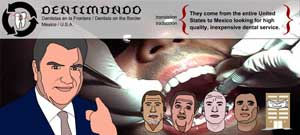
Dentimundo is a new online directory of Mexican dentists on the border with the United States.
El Progresso, Ojinaga, Juarez, Nogales, Mexicali, Tijuana, are all Mexican towns or cities that sit on the edge of the United States. These are border sites that have established a direct simbiotic relationship with the U.S. economy by providing a variety of services to U.S. citizenry and attracting U.S. dollars. Dentist clinics are as prominent as three for a dollar tacos, margarita specials and Mexican panchos.
What deficits in the U.S. health system is causing this outflow to Mexico? How do the dentists on each side of the border view one another? Where do U.S. citizens prefer to have their teeth cleaned and why? These are just a few of the questions that come to mind when considering the immense quantity of Mexican dentists along the Mexico/United States border.
Dentimundo.com is a multimedia documentary of this micro-economy between the U.S. and Mexico that investigates border dentistry while also presenting users with a directory of dentist clinics along the border.